
For many growing businesses, approving a simple vendor payment is not always simple.
A founder may open three different banking apps to check balances before approving a payment. One account holds surplus cash, another is close to the minimum balance, and a third receives customer payments. By the time the total position becomes clear, the decision is already delayed.
This situation is common among SMBs and MSMEs. Businesses often keep funds across multiple bank accounts approvals move through messages or emails, and finance teams rely on spreadsheets that update only once or twice a week.
In many cases, the business is not short of money. The real problem is a lack of financial visibility. When founders cannot clearly see where money sits at any moment, even routine financial decisions become slower.
What Real-Time Financial Visibility Means
Real time financial visibility means seeing the full financial position of a business instantly without combining data from different systems.
For SMBs and MSMEs, this includes the total cash balance across all bank accounts, visibility into incoming payments and upcoming expenses, and a clear view of available liquidity for daily operations.
It is not just about checking balances. It helps founders understand how much money is available before making financial decisions.
Why Financial Visibility Becomes Critical as Businesses Grow
In the early stages of a business, financial activity remains simple. A company may operate with one or two bank accounts and a small number of transactions.
As the business grows, financial operations become more complex.
Companies often maintain multiple bank accounts for collections and payments. Vendor payment volumes increase. Payroll and statutory obligations must be managed regularly. Customer payments may follow different cycles every month.
This complexity creates three common risks when real-time visibility is missing.
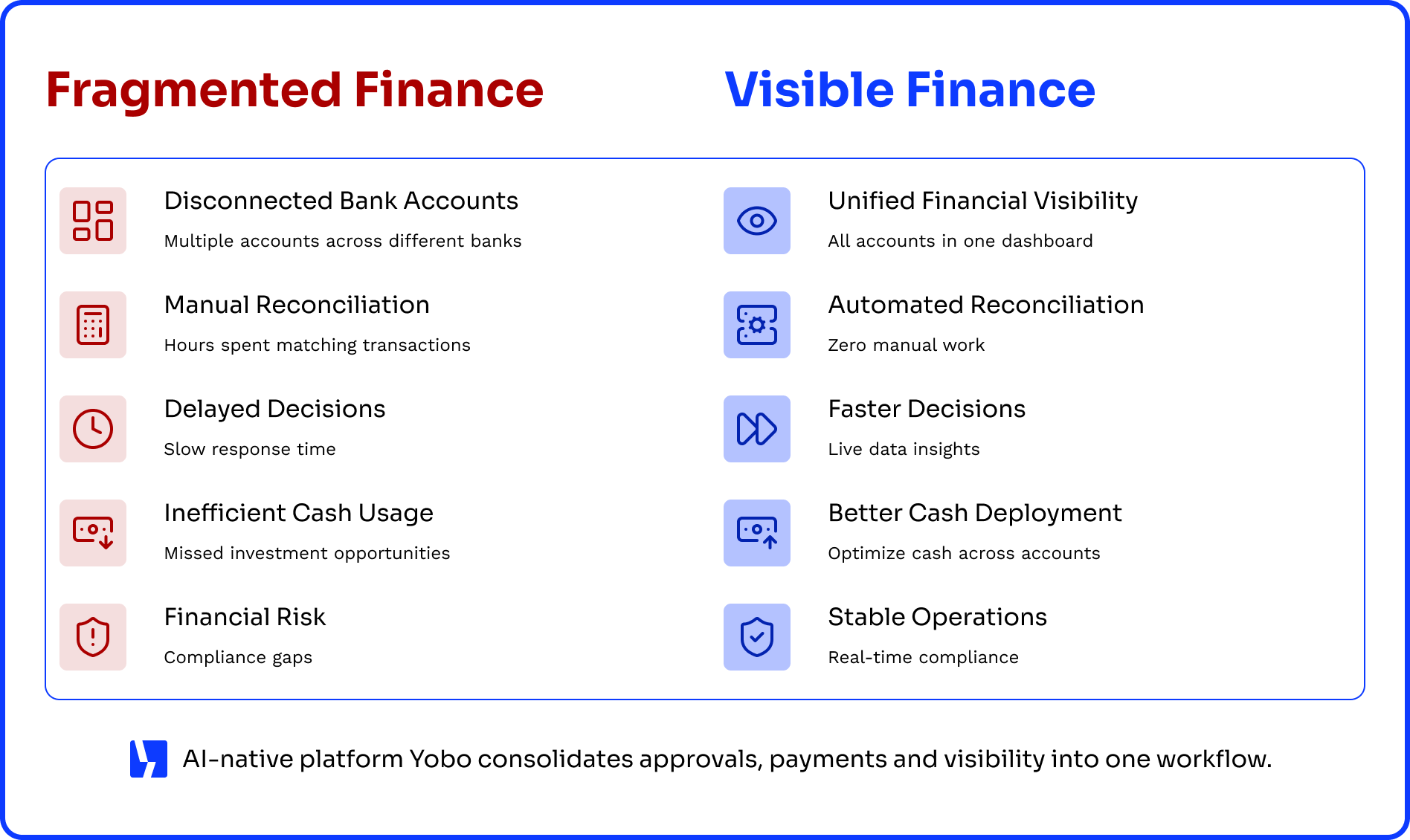
The first risk is delayed decisions. Payment approvals often wait while teams confirm balances across accounts. This slows operations and creates unnecessary friction.
The second risk is inefficient use of cash. Idle funds may sit in one account while another account faces a shortage. Without a clear view of total liquidity, businesses cannot allocate funds efficiently.
The third risk is operational stress. Finance teams spend hours reconciling numbers manually. Instead of focusing on planning and analysis, they spend time collecting data.
As financial activity grows, visibility stops being a simple reporting feature. It becomes an operational necessity.
What Changes When Businesses Gain Financial Visibility
When businesses gain better financial visibility, several operational improvements appear quickly.
Payment approvals become faster because decision makers already know the available cash position. Teams no longer need to confirm balances across different accounts.
Cash shortages also become easier to predict. Instead of discovering a problem after it occurs, finance teams can identify upcoming gaps in advance.
At the same time, surplus funds become easier to identify. Businesses can move idle cash into better uses or short-term investments.
Borrowing decisions also become more structured. Companies can determine whether they truly need external financing or whether internal liquidity can support operations.
Most importantly, businesses move from reacting to financial problems toward anticipating them.
Instead of asking, “Do we have enough money today?”, founders start asking, “What will our liquidity position look like next week?”
This shift improves financial confidence and decision quality.
How Technology Is Improving Financial Visibility
In the past, achieving financial clarity required significant manual work.
Finance teams downloaded bank statements, updated spreadsheets, and built internal reports to understand liquidity. This process consumed time and often produced outdated information.
Modern financial platforms now automate much of this work.
AI-native systems can connect multiple bank accounts and consolidate financial data into a single dashboard. They track inflows and outflows in real time. They highlight liquidity trends and support faster payment approvals.
Platforms such as Yobo provide this consolidated financial view for SMBs without requiring complex treasury infrastructure. Instead of relying on spreadsheets and manual checks, founders can see their financial position instantly.
The goal is simple; business owners should understand their financial position clearly before making decisions.
Final Takeaway
Financial visibility is not only a finance team requirement. It is a decision-making advantage.
Businesses that clearly understand their liquidity position can approve payments faster, avoid unnecessary borrowing, and use their capital more efficiently.
As transaction volumes increase, financial clarity becomes just as important as financial performance.
The businesses that scale smoothly are usually the ones that can see their money clearly before they move it.